I love a good conspiracy.
I don’t believe in many of them, pretty sure the Earth is round, the Holocaust was real, vaccines are good, and jet fuel can sufficiently soften steel rebar to make reinforced concrete blocks collapse after a physical trauma such as an explosion from a passenger aircraft collision.
But I love the idea behind conspiracies. That you could somehow convince enough people to lie about something or at least believe in a lie to act as corroborating sources.
I even have favourites.
Was there a second gunman at the JFK assassination? Who was the figure behind the grassy knoll? The best version of events I heard was from a friend of mine who claimed JFK was shot by one of his own security people. Hearing the first gunshot from Lee Harvey Oswald, which missed, one of the guards pulls his gun instinctively but poor trigger discipline meant that the gun went off mid-draw and by pure chance, dealt the kill shot. The grassy knoll is therefore misinformation to give an alternative explanation who aren’t happy with the much simpler version of events, that a sniper in a book repository shot him.
The thing that I like about this theory is it has a reason behind it. Covering up an accident which would embarass the security services.
Most conspiracy theories have no motivation.
Why would doctors lie about vaccines? Why would NASA lie about the shape of the Earth? Why would someone lie about a pre-existing floating table prop¹?
A few posts ago I talked a bit about Dirk Losander and the persuit for perceived authenticity. In this I mentioned a little bit of side research I did into the claims that he did not in fact invent the basic floating table[citation needed].
So the thing I was certain about is that if the floating table has a prop on top of it, particularly if there is a moment in the routine where the performer lets go of the tablecloth entirely to inspect said prop, that’s 100% a Losander table or a derivative, and since Losander hasn’t licensed anyone to make a derivative, it would be a knockoff.
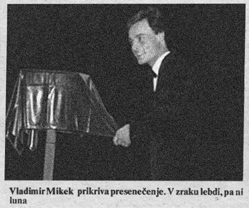
But a name cropped up in a search, Vladimir Mikek. Vladimir is a Slovenian magician who was said to be performing this effect a decade earlier. When I reached out to ask if this was true or his name was just being used to defend piracy, he did even better than confirming or denying, he actually pointed me to a page on his website with a scan of a newspaper dated September 22nd 1982, with a photograph at the bottom of Vladimir floating a table.
That’s conclusive proof right?
Right?
Well I thought so but it had a bit of a smell about it. I can’t describe it, but after posting that article, I just went back and wondered why the newspaper had posted an article about him. I like reading stories about magicians, and wondered if Vladimir was in some way exceptional in his home country, to warrant the coverage. So I found some international OCR software and translated the text as best I could into English. It appeared to be a puff piece about a magic club holding a show. It used a lot of witchcraft metaphors which made it a difficult read since that kind of thing is always hard to translate². Vladimir Mikek presumably is their star performer.
So why did this article trigger my suspicions in the afterglow of a good days research? Well there are 3 pictures on the page, presumably all of Vladimir although only 2 bear his name.
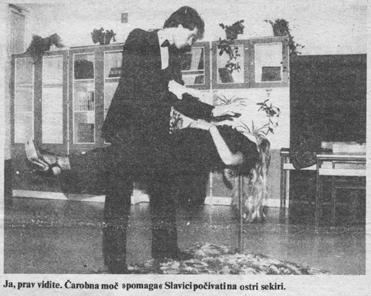
Picture 1:
Caption:
Yes, you see. The magical power of the Slavics helps to rest with a sharp axe.
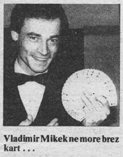
Picture 2:
Caption:
Vladimir Mikek can’t do without cards…
And of course picture 3:
Caption:
Vladimir Mikek hides a surprise. It’s floating in the air, but it’s not the moon
The first thing that got me was the fact that the lighting in picture 3 is different. The first two photos have the skin tones flushed out to pure white, with stark crushed low lights in the shadows either under a spotlight or a flashbulb. But the third image we see a lot of grey tones and the shading suggests it is lit both from the side and with a more diffuse ambient light.
This suggests that the photo may have been taken:
- In a different place
- At a different time
- With a different camera
And the caption sort of suggests a spherical levitation. So consider a sligtly different series of events.
The following is hypothetical:
On the 22nd of September 1982 a small local paper sends J. Zupanič³ to KUD Jože Hermanko⁴, where Mariborski čarodeji⁵ did a show to celebrate their 15th year. In this show the headliner, Vladimir Mikek performed some card tricks, an Axe themed suspension and a zombie ball. These are captured in photographs for the article. Vladimir keeps a copy of the article for his personal pin board. Years later, after 1997, someone starts to produce replica Losander Tables. Someone with ties to Mariborski čarodeji⁵. In order to protect themselves from legal attacks, someone scans the article and replaces the zombie ball photo with a photograph of Vladimir performing with one of these floating tables. This article is then shared on Slomagic.

In these parts we like to have a little thing called evidence.
The only thing that can reall solve this is an archive copy of the newspaper this article came from. Unfortunately I don’t know what paper this is from, but context clues in the translated text keep pointing to Maribor, second largest city in Slovenia and the economic, administrative, educational, and cultural centre of eastern Slovenia⁶. Maribor is also the home of Vecer, a publishing company responsible for a lot of Slovenian Newspapers. They even have an archive going back to 1945.
Now I need to battle with Google’s screen translate and the Vecer app to sign up for archive access and try to find the original article. It may even just be text with no images which won’t help at all.
This is where I’m ending the post, with a cliffhanger. In a future post one of the following things will be revealed.
- The source matches the scan and the floating table existed back in 1982.
- The source does not match the scan and there is a conspiracy to fabricate a pre-existing floating table.
- The archive does not contain the photographs and Unless someone else is scanning the papers we will never know.
- The archive does not contain this article and the search continues.
- I cannot log into the archive and I havent got a clue what the fuck to do next.
Yeah those last 3 would be super disappointing but before I post this I want to reassert that I actually have zero skin in this game and don’t care if Losander actually invented the floating table or not. I just want the truth and I love doing research. This is like a real life puzzle from The Roottrees are Dead⁷.
When I explained what the hell I was doing to my wife she suggested that this kind of research might make a good talk for The Magic Circle. Personally I think the base assumption (Dirk Losander invented the floating table) would be a little too obvious to give a talk about and the process of verification would need some padding to fill yhe hour. The alternative is that its genuine, in which case the research then becomes incomplete until I can find who actually did invent it.
I guess soon we’ll see how much work I have left.
¹ There is an obvious answer to this. Say it with me: If the table predates Losander and no one else is defending it as an original invention then every alternative table becomes legitimate. Oh sorry that explanation was a bit longer than I expected, it’s okay if you didn’t match it word for word. But why would an individual quietly set themself up as the linchpin of an argument like this?
² We’ve all heard about Darmok and Jalad at Tanagra, right?
³ J. Zupanič is the author signoff at the bottom of the article. Unfortunately searching for this writer has proved difficult because against all odds, Zupanič is quite a common name in Slovenia and a lot of Slovenian names start with J.
⁴ Jože Hermanko cultural centre, named for Jože Hermanko a resistance fighter considered a hero for his help in the stuggle for Slovenian independence. This also makes it hard to search for as many roads appear to be named after Jože Hermanko.
⁵ Maribor Wizards, which as far as I can tell is basically the Slovenian equivalent of the Magic Circle (Čarobni krog). Many small countries have a local magic club acting as the defacto national magic society.
⁶ Thanks Wikipedia.
⁷ The Roottrees are Dead is a detective game where you have to research a family tree, starting with fictional web searches and slowly expanding the list of sources, periodicals, etc. from which to deduce new information.