Sometimes I read something and wonder if I’m having a brain heammorrage.
It’s like the words in their particular order make so little sense that either I have forgotten how to read or the author of the words is insane, and I am surprisingly not egotistical enough to assume the latter every single time.
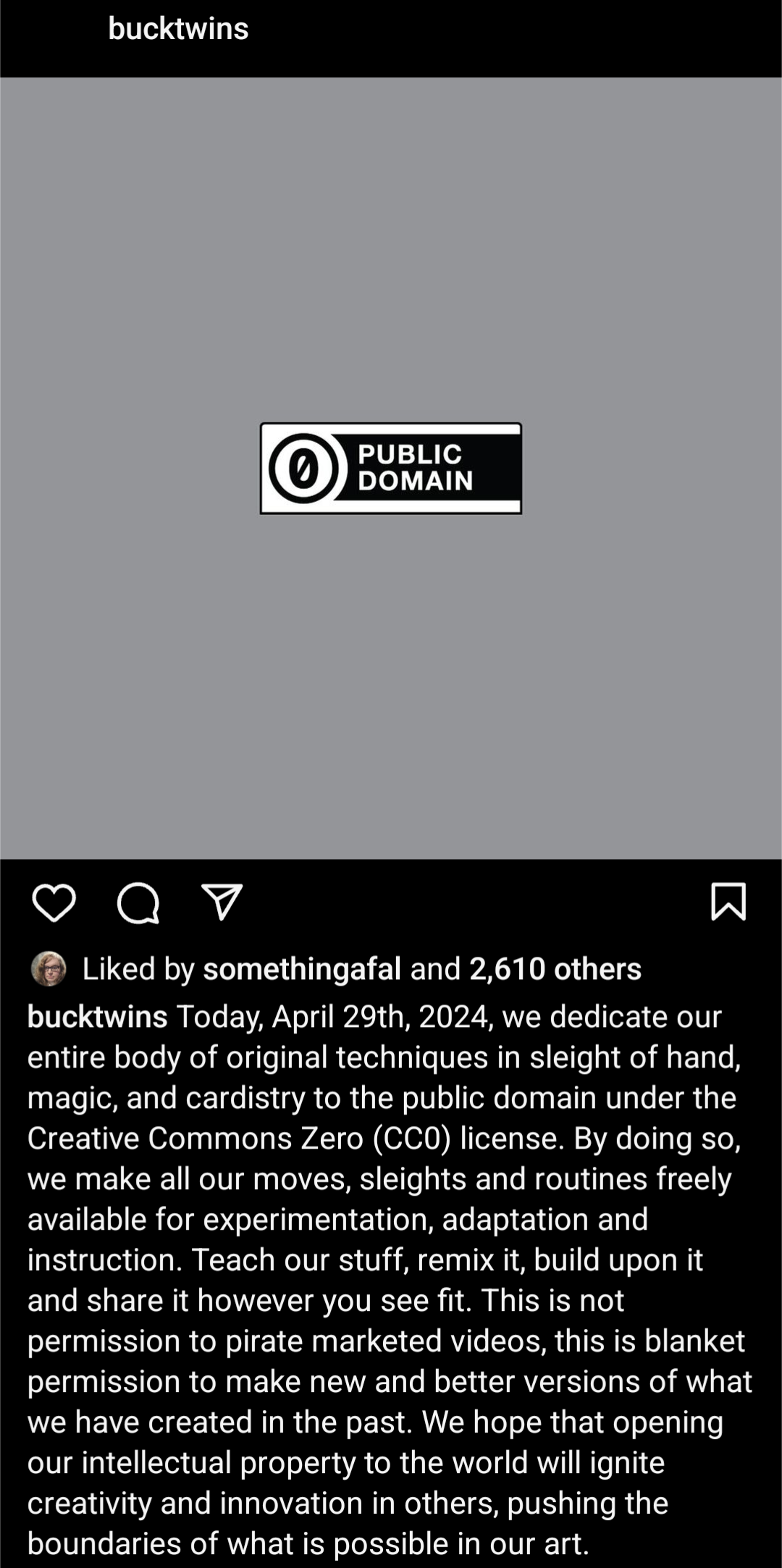
Thats the sense I had today when I was told that Dan and Dave, one of many famous sibling groupings known colloquially as the Buck Brothers, were putting all their work in the public domain, a statement backed by a post on their Instagram.
Why do they call it oven when you of in the cold food of out hot eat the food?
I feel like the messaging here is getting muddled, let me start again.
Did you hear that the world famous painter, Thomas Kinkade has decided to make all his past works public domain?
Oh, that doesn’t mean you can make copies of his work, after all he still sells it. Rather, you’re allowed to paint in the same way he does, and teach others to do the same. In fact, he’ll even let you paint better better than him by improving on his technique! What a philanthropist.
What’s really going on here?
Recently a really important thing happened in the world of copyright. A classic piece of media from the last century, one which was considered a foundational example to its industry, entered the public domain. I am of course talking about Corinda’s 13 Steps to Mentalism¹.
This book contains secrets such as how to surreptitiously write something in plain sight, read things that people wrote in secret, construct a magic square, use a memorised stacked card deck, make predictions, see through blindfolds, send silent messages to an assistant and so forth. My favourite part is the section on how to make green fire, because I am 99% sure that if you went to a chemist today with that shopping list, you would immediately be arrested.
The point is that I have read books, watched videos and attended lectures in which all these things were taught and discussed, long before Corinda’s work fell into public domain. How was that allowed to happen?
Well, as I love to say on here: You cannot copyright the method of a magic trick.
You can copyright the script, the choreography, the name, the artwork, but the method is unboxable.
If it requires a special piece of apparatus you can patent its mechanisms but that won’t stop people making a version which works differently² and also requires that the method is a matter of public record, and therefore inherently not a secret anymore.
The fact is, all around the world, people have been performing the sleights and routines they learned from Dan and Dave for years. Some of those performances were in magic clubs and probably included a second rendition, much slower, with the patter altered to explain how it was done. This is what we in the business call teaching³.
One of my favourite stories about Dan and Dave doesn’t actually involve them at all, but they get namechecked in it.
A friend of mine was performing some card magic at a convention when a young whippersnapper commented on his Dan and Dave Shapeshifter Change. My friend responded that it was actually an Ed Marlo Snap Change. The youth said “Ed Marlo shouldn’t be going around teaching that because he copied it from Dan and Dave.”
Ed Marlo died in 1991. Dan and Dave started their Magical Career in 2001.
But that’s okay, because as I stated, legally⁴ anyone can teach a magic trick and call it anything they want.
The Public Domain
The public domain is a super important concept. It is a way of taking a cultural artifact and saying “this belongs to everyone now”.
As such it is controlled with great specificity. The works of shakespeare are in the public domain, meaning anyone can reproduce them word for word. This specific right is what then allows people to alter them and create new works based on them. Otherwise even altered versions can be considered a partial copy.
When the stories of Sherlock Holmes began to enter the public domain the people who had formerly owned those works after the death of Sir Arthur Conan Doyle were incredibly litigious about what exactly people could do with the works. Indeed several of Sherlock Holmes more famous personality traits were not mentioned until later stories, and so early adaptations could not portray those aspects of the character. This includes the absolutely ridiculous assertion at one point that Netflix’s adaptation Enola Holmes showed Sherlock being nice to women, which the estate insisted didn’t happen until the very last few stories still under copyright.
So I guess what I’m saying is that this is a nice way to seem like they’re doing a good thing, and it sort of opens up the gentlemen’s agreement of “Don’t publish a trick you didn’t invent” but it has nothing to do with the public domain or Creative Commons.
To declare a specific work as being CC0 or public domain it has to be published by the rights holder along with the declaration that it is in the public domain.
A good way to tell the difference between what Dan and Dave announced and the public domain is to use the example of Wintergatan and freePD.
Wintergatan retain all the rights to their music but you can download it for free and also obtain a free license to use it in live streaming and YouTube videos. You can also download the sheet music and use it to play the songs yourself or teach them to music students. These are explicitly the declared uses. Can you sell an album of yourself playing these songs? I don’t actually know, it isn’t explicitly covered in the license.
FreePD states all the music there is free to download and use as you like. You can even burn it to CDs and sell it with your own name on. That simple.
That’s the difference between the public domain and a free license for limited use cases.
Except they aren’t even offering that because as people are arguing in the comments, you still have to buy their piblications, they have no oblication to make them available even if they were making them public domain, but they’re explicitly telling people not to duplicate their published work, which means none of it is public domain.
What they’re saying is that if you buy their videos you can show people what you learned from them and try to improve from them.
Which you always could.
I feel like I’m losing my goddamned mind.
¹ Be honest, how many of you thought I was going to say Steamboat Willy? This is, according to the book I am currently reading (Be Funny or Die by Joel Morris) a “Joke”.
² There are actually lots of tricks which appear on the surface to be identical but use wildly different mechanisms. Ironically none of them were done this way to get around a patent but rather intended to present themselves as better than their predecessors for marketing purposes. I have written extensively about this before.
³ Well okay, some people call it exposure but guess what, that’s not illegal either and theyre functionally identical when the recipient is also well versed in the magical arts.
⁴ You might be shunned by the magical community such that it is, but if you’re well liked people may ascribe it to crypomnesia or sufficiently improved to count as its own thing. If you sell it way cheaper than the original you may even be hailed as a hero, like Dave Bonsall. But legally no one is out there trademarking their pushoff double lift or patenting a particualrly innovative copper silver bass gimmick.